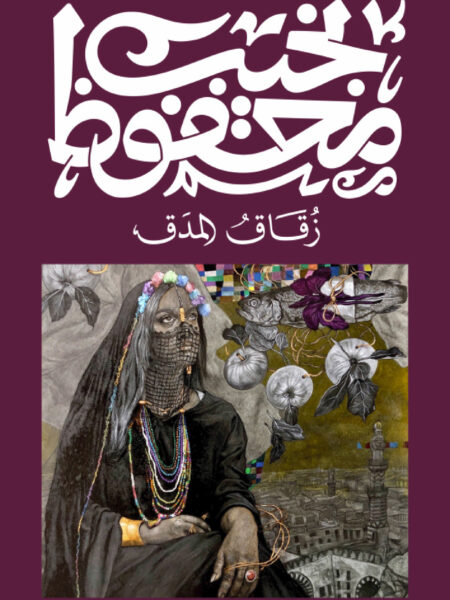
Book page
Midaq Alley
Zuqaq al-Madaq (Midaq Alley) by Egyptian Nobel laureate Naguib Mahfouz is one of his most important realist novels, depicting life in a popular Cairo alley during the 1940s. The story revolves around a small neighborhood filled with diverse characters representing different social backgrounds, whose lives intertwine through ambition, poverty, and social change. The central character, Hamida, seeks to escape her humble surroundings in pursuit of a more luxurious life, leading her into complex paths that reveal the conflict between desire and morality. The novel vividly portrays social and moral transformations in Egyptian society and showcases Mahfouz’s mastery in depicting human psychology with depth and realism.
About this book
Zuqaq al-Madaq (Midaq Alley) by Egyptian Nobel Prize-winning author Naguib Mahfouz is considered one of the most significant works of social realism in Arabic literature. Through this novel, Mahfouz presents a vivid and detailed portrayal of life in a Cairo alley during the 1940s, capturing its simplicity, struggles, and profound social transformations.
The story unfolds within a narrow alley that functions as a microcosm of society, inhabited by a diverse group of characters representing different social classes and professions, such as the barber, the café owner, merchants, and ordinary residents. Rather than portraying them superficially, Mahfouz develops each character with deep psychological insight, revealing their dreams, fears, motivations, and contradictions. In doing so, the alley becomes a symbolic space that reflects society as a whole.
At the center of the narrative is Hamida, a young and ambitious woman who grows increasingly dissatisfied with her humble surroundings. Driven by her desire for a more glamorous and prosperous life, she seeks to escape her environment, a decision that leads her into a series of difficult and transformative experiences. Her journey highlights the tension between social ambition and moral values, as well as the consequences of pursuing dreams without balance or awareness.
The novel also reflects the broader social and economic changes taking place in Egyptian society during that era, particularly the clash between tradition and modernity, and between simple communal life and the allure of urban transformation. Mahfouz’s realistic and detailed narrative style immerses the reader in the alley’s daily life, making its characters and events feel immediate and alive.
Ultimately, Midaq Alley is not merely a story about a neighborhood, but a profound human study of ambition, moral conflict, and the search for identity. It stands as one of Mahfouz’s most powerful explorations of human nature and social reality in all its complexity.
The story unfolds within a narrow alley that functions as a microcosm of society, inhabited by a diverse group of characters representing different social classes and professions, such as the barber, the café owner, merchants, and ordinary residents. Rather than portraying them superficially, Mahfouz develops each character with deep psychological insight, revealing their dreams, fears, motivations, and contradictions. In doing so, the alley becomes a symbolic space that reflects society as a whole.
At the center of the narrative is Hamida, a young and ambitious woman who grows increasingly dissatisfied with her humble surroundings. Driven by her desire for a more glamorous and prosperous life, she seeks to escape her environment, a decision that leads her into a series of difficult and transformative experiences. Her journey highlights the tension between social ambition and moral values, as well as the consequences of pursuing dreams without balance or awareness.
The novel also reflects the broader social and economic changes taking place in Egyptian society during that era, particularly the clash between tradition and modernity, and between simple communal life and the allure of urban transformation. Mahfouz’s realistic and detailed narrative style immerses the reader in the alley’s daily life, making its characters and events feel immediate and alive.
Ultimately, Midaq Alley is not merely a story about a neighborhood, but a profound human study of ambition, moral conflict, and the search for identity. It stands as one of Mahfouz’s most powerful explorations of human nature and social reality in all its complexity.
Why read it?
We read Midaq Alley by Egyptian Nobel laureate Naguib Mahfouz because it offers a realistic and profound portrayal of social life in a traditional Cairo neighborhood, revealing the complexities of human nature and the conflict between ambition and moral values. The novel helps readers understand the social and economic transformations that shape individual behavior, while raising important questions about freedom, choice, and the cost of pursuing one’s dreams. It is a literary work that combines engaging storytelling with deep human insight, offering a rich reflective reading experience.
Who is it for?
Midaq Alley by Egyptian Nobel laureate Naguib Mahfouz is intended for readers who appreciate realist literature that reflects the details of life in traditional and working-class communities. It is especially suited to those who enjoy novels that explore human psychology and inner conflicts. The book also appeals to readers interested in themes of ambition, social class, and cultural transformation within society.
Book details
Language
ar
ISBN-13
9789778616293
Page count
304
Age rating
General