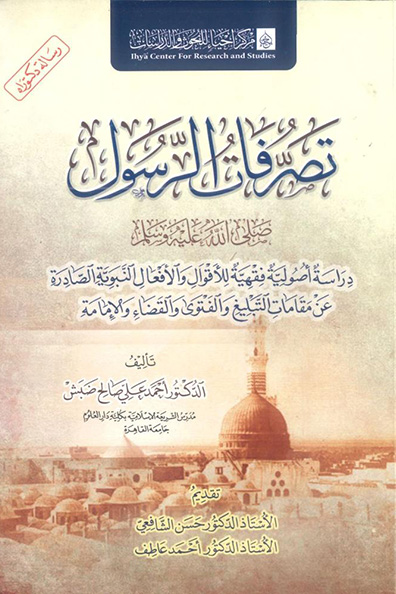
Book page
The Messenger’s Conduct
A foundational study in Islamic jurisprudence analyzing the different capacities and roles of Prophet Muhammad (such as leader, judge, mufti, and human) and their legislative impact.
About this book
In this pivotal work of legal theory (Usul al-Fiqh), Dr. Ahmed Ali Saleh Dabash addresses a crucial topic in Islamic jurisprudence: categorizing the various roles and capacities of Prophet Muhammad.
The author analyzes whether specific prophetic actions were executed in his capacity as a messenger conveying universal revelation, a head of state leading the community, a judge settling disputes, or an individual acting on human nature. The book demonstrates how conflating these capacities leads to misunderstandings of Islamic law, providing rigorous scholarly criteria to distinguish between binding, eternal religious rulings and contextual, administrative policies.
The author analyzes whether specific prophetic actions were executed in his capacity as a messenger conveying universal revelation, a head of state leading the community, a judge settling disputes, or an individual acting on human nature. The book demonstrates how conflating these capacities leads to misunderstandings of Islamic law, providing rigorous scholarly criteria to distinguish between binding, eternal religious rulings and contextual, administrative policies.
Why read it?
Read it to gain a refined jurisprudential understanding of the Prophetic Sunnah, learning how classical scholars differentiated between universal divine law and contextual administrative actions.
Who is it for?
Essential for students and scholars of Islamic jurisprudence, legal philosophy, Islamic governance (Siyasa Shar'iyya), and readers interested in Islamic law reform.
Book details
Language
ar
ISBN-13
9789778598315
ISBN-10
9778598312
Page count
503
Age rating
General