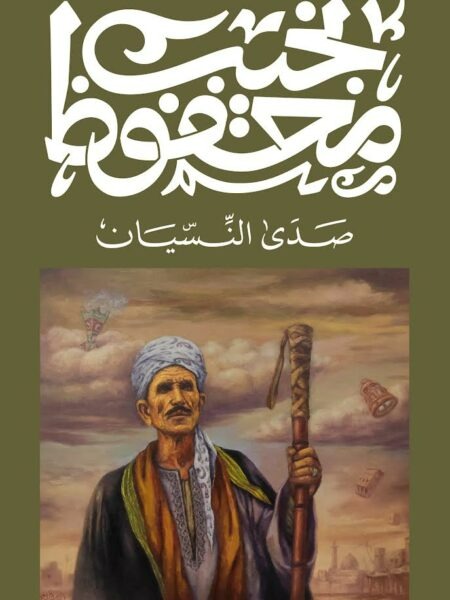
Book page
Echo of Forgetfulness
This short story collection by Egyptian Nobel laureate Naguib Mahfouz presents vivid scenes from the Egyptian neighborhood, rich in social and human detail. The stories explore themes such as memory, power, repentance, and human transformation, as seen in “Echo of Forgetting,” where the past re-emerges in a person’s behavior despite changes in belief and faith. Through his realistic and profound style, Mahfouz portrays a vibrant world that reflects the complexities and contradictions of human life and society.
About this book
“My friend laughed for a long time, yet his hand never stopped sketching. He knew very well that I was not thinking about investment. What I had hoped for was to establish a popular rest house, built from memories and dreams, offering an escape from the burdens and pressures of life. Once furnished and decorated by the shops of Khan El Khalili, it would become a masterpiece.”
In this engaging collection of short stories, Naguib Mahfouz presents a series of vivid and living scenes that capture the unique atmosphere of the Egyptian neighborhood (the alley). These scenes come alive between the lines, rich with detail and vitality.
In “The Rose Garden,” the death of Hamza Qandil reveals many of the concepts held by the neighborhood regarding the sanctity of the dead, a sanctity deeply rooted in religion itself. In “Echo of Forgetting,” the thug “Anbar” does not forget his past actions of bullying and domination before his heart turned toward faith and he found the path of God; however, he returns to practice the same behaviors with his followers—who walk in his footsteps—yet this time the domination is carried out under white robes and turbans, and under the chant of “Allahu Akbar.”
In “The Ascent to the Moon,” the dream of authenticity and the longing to return to the old ways—those that resemble us—becomes evident. These and many other details define the distinctive world of Mahfouz’s alley, a world full of life, contradictions, and deeply human experiences.
Titles of this kind often attract readers interested in time, identity, recollection, emotional residue, and the inner life of remembrance. Without claiming unsupported details about the text itself, this book can be positioned as a thoughtful literary work for readers who appreciate nuanced language, reflective themes, and fiction or prose that invites interpretation rather than offering simple conclusions.
From a bookstore perspective, it is a strong discovery title for readers searching for Arabic literary books by Naguib Mahfouz, as well as for anyone drawn to contemplative works centered on memory and loss. It also suits quiet personal reading, literary discussion groups, and readers seeking Arabic books with emotional and philosophical depth.
In this engaging collection of short stories, Naguib Mahfouz presents a series of vivid and living scenes that capture the unique atmosphere of the Egyptian neighborhood (the alley). These scenes come alive between the lines, rich with detail and vitality.
In “The Rose Garden,” the death of Hamza Qandil reveals many of the concepts held by the neighborhood regarding the sanctity of the dead, a sanctity deeply rooted in religion itself. In “Echo of Forgetting,” the thug “Anbar” does not forget his past actions of bullying and domination before his heart turned toward faith and he found the path of God; however, he returns to practice the same behaviors with his followers—who walk in his footsteps—yet this time the domination is carried out under white robes and turbans, and under the chant of “Allahu Akbar.”
In “The Ascent to the Moon,” the dream of authenticity and the longing to return to the old ways—those that resemble us—becomes evident. These and many other details define the distinctive world of Mahfouz’s alley, a world full of life, contradictions, and deeply human experiences.
Titles of this kind often attract readers interested in time, identity, recollection, emotional residue, and the inner life of remembrance. Without claiming unsupported details about the text itself, this book can be positioned as a thoughtful literary work for readers who appreciate nuanced language, reflective themes, and fiction or prose that invites interpretation rather than offering simple conclusions.
From a bookstore perspective, it is a strong discovery title for readers searching for Arabic literary books by Naguib Mahfouz, as well as for anyone drawn to contemplative works centered on memory and loss. It also suits quiet personal reading, literary discussion groups, and readers seeking Arabic books with emotional and philosophical depth.
Why read it?
We read this short story collection by Egyptian Nobel laureate Naguib Mahfouz because it offers a realistic and profound portrayal of life in the Egyptian neighborhood, reflecting the richness and contradictions of everyday human experience. The stories reveal the complexities of human nature between good and evil, change and the lingering presence of the past, while also inviting reflection on themes such as power, repentance, memory, and identity. It is a meaningful reading experience that helps the reader understand human beings within their social and psychological contexts through a powerful yet accessible literary style.
Who is it for?
This short story collection by Egyptian Nobel laureate Naguib Mahfouz is intended for readers who appreciate realistic literature that reflects the details of everyday life in Egyptian society. It is especially suited for those who enjoy short stories with deep human insight, exploring the transformations of human nature within vibrant social settings. The book also appeals to readers interested in themes such as memory, power, repentance, and the inner struggle between good and evil.
Book details
Language
ar
ISBN-13
9789778800104
Page count
120
Age rating
General