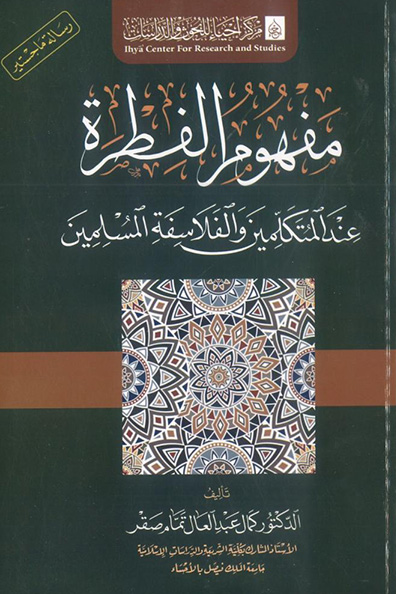
Book page
The Concept of Fitrah among Muslim Theologians and Philosophers
An academic and critical study exploring the epistemological and theological manifestations of the concept of Fitrah (primordial nature) among Muslim theologians (Mutakallimun) and philosophers.
About this book
In this critical study, Dr. Kamal Abdel-Aal Tammam Saqr explores a foundational doctrine in Islamic intellectual history: the concept of Fitrah (human's innate, dispositional nature) and its divergent interpretations among Islamic theologians (Mutakallimun) and Muslim philosophers (Falasifa).
The author investigates how theological schools (Ash'arites, Maturidites, and Mu'tazilites) framed Fitrah as a cognitive capacity for faith and rational deduction, contrasted with philosophical perspectives (such as those of Al-Farabi, Avicenna, and Averroes) that approached it as a potentiality toward intellectual and existential perfection. Through systematic textual analysis, Dr. Saqr offers a comprehensive evaluation of how Fitrah connects to Islamic epistemology, ethics, and human agency.
The author investigates how theological schools (Ash'arites, Maturidites, and Mu'tazilites) framed Fitrah as a cognitive capacity for faith and rational deduction, contrasted with philosophical perspectives (such as those of Al-Farabi, Avicenna, and Averroes) that approached it as a potentiality toward intellectual and existential perfection. Through systematic textual analysis, Dr. Saqr offers a comprehensive evaluation of how Fitrah connects to Islamic epistemology, ethics, and human agency.
Why read it?
Read it to gain a well-documented, objective understanding of how the innate human disposition (Fitrah) was conceptualized across classical Islamic theology and philosophy.
Who is it for?
Essential for researchers and students of Islamic theology (Kalam), philosophy, epistemology, and readers interested in classical intellectual history.
Book details
Language
ar
ISBN-13
9789778652208
ISBN-10
9778652201
Page count
461
Age rating
General